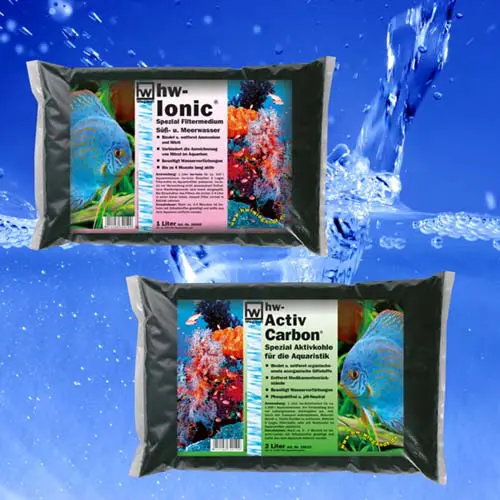
hw specialist filter media for marine aquariums
Clear water helps an aquarium look its best, and effective filtration plays an essential part. Filtration must do more than capture suspended particles: it also needs to address dissolved organic and inorganic pollutants. Specially prepared, high-performance activated carbons and other specialist media are designed for these tasks.
For hw filter media, we select high-purity activated carbons together with mineral and semi-synthetic carrier materials. These are treated and combined to target particular pollutants. They complement conventional materials such as filter wool, fleece, foam, clay and ceramics by binding and neutralising dissolved pollutants, colourants and other unwanted substances that conventional media may not adequately remove.

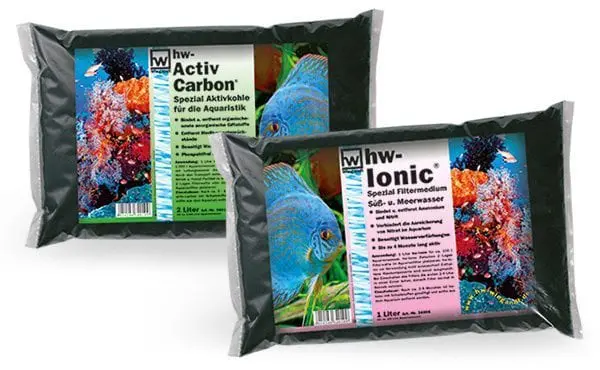
hw ActivCarbon
Activated carbon for targeted water treatment
hw ActivCarbon is a specially prepared activated carbon for freshwater and marine aquariums. It is pH-neutral and phosphate-free. Suitable dissolved substances can bind to its porous internal surface. This process is called adsorption.
Applications include reducing discolouration caused by organic substances and removing suitable medication residues after a treatment has been completed. The substances adsorbed and the useful life of the carbon depend on the properties of those substances, the pollutant load and operating conditions.
Large internal surface area
The internal surface area of hw ActivCarbon is approximately 950–1,300 m²/g. For 3 g, this gives a calculated area of approximately 2,850–3,900 m². This figure describes the pore structure of the carbon; it does not guarantee the removal of every pollutant.
When using it after medication, follow the instructions for the treatment concerned. Monitor the relevant water parameters and replace exhausted activated carbon.
Dosage and preparation
Use 1 litre of hw ActivCarbon for approximately 1,000 litres of aquarium water. Before use, rinse the material briefly with tap water to remove dust and fine particles caused by transport.
Place hw ActivCarbon between two layers of filter wool in an external filter or in a suitable mesh bag in the aquarium filter.
Service life
The intended service life is approximately three to four weeks. Actual saturation depends on the pollutant load and the substances adsorbed. Monitor filter performance and remove or replace exhausted activated carbon.
Use activated carbon to remove medication residues only after the treatment has been completed, following the instructions for the medication concerned.

hw ionic: activated carbon and ion exchange combined
hw ionic is a filter medium for freshwater and marine aquariums. It combines specially prepared and pretreated activated carbon based on hw ActivCarbon with selected ion-exchange resins. The mixture binds substances including ammonium and nitrite and can thereby reduce their conversion to nitrate. Nitrate already present is bound only to a limited extent.
The medium does not require a biological start-up period for its binding action. Whether an aquarium is ready for livestock must still be assessed from its water parameters and the capacity of the whole system. In particular, monitor ammonium/ammonia and nitrite; using the medium alone does not mean that livestock can be added immediately.
The manufacturer’s figure of “100 bar” describes an equivalent of the force retaining bound substances. It does not describe an actual vacuum generated in the filter.
Dosage and installation
Use 1,000 ml of hw ionic per 100 litres of freshwater or marine water. Always place the medium between two layers of filter wool, each at least 2.5 cm thick. Do not use a mesh bag: coarse mesh can allow fine resins to escape, while very fine mesh can clog.
Do not rinse hw ionic before installation. Rinsing could wash out the fine ion-exchange resins.
When switching the filter on, direct the first 2–4 litres of water into a bucket, then operate the filter as usual.
Service life and monitoring
With normal stocking, the usual service life is around three to four months. It depends on stocking and pollutant load. Replace the medium when its adsorption capacity is exhausted. Check water parameters regularly with suitable tests, particularly nitrite.
If nitrate is already elevated, carry out an appropriate water change before use. Base water changes and further measures on measured values and the needs of your livestock.
Looking for additional hw® products?
You will find all hw® products in our product catalog.
Filtration in marine aquariums: equipment, filter media and maintenance
A suitable filtration system helps maintain water quality. Choose the equipment and media to suit the aquarium volume, livestock and substances you need to remove.
What do different filter media do?
- Mechanical filtration: filter wool, fleece and sponges trap suspended particles and debris.
- Biological filtration: colonisation surfaces support microorganisms that convert ammonium or ammonia via nitrite into nitrate.
- Adsorptive and chemical filtration: suitable media bind particular dissolved substances. Select a medium for the substance you want to remove.
Internal, external or nano filter?
Internal filters sit inside the aquarium; external filters are installed outside it. Nano filters are designed for small aquariums. Check the manufacturer’s recommendations for aquarium capacity, flow rate, filter volume and suitability for saltwater.
How do you choose the right filter size?
Consider water volume, stocking, waste production, nutrient levels and the contact time required by the media. Actual flow depends on the media, hoses and accumulated dirt. Follow the equipment and media manufacturers’ instructions.
What does a protein skimmer do?
A protein skimmer removes some organic substances before they break down. In marine aquariums, it complements mechanical, biological and other appropriate filtration methods.
Which hw filter media are available?
hw ActivCarbon is activated carbon for freshwater and marine aquariums. hw ionic combines activated carbon with ion-exchange resins and binds ammonium and nitrite. It binds existing nitrate only to a limited extent. Follow the specific dosing and application instructions.
How often should a filter be cleaned?
Check flow and condition regularly. Clean mechanical components as needed. Care depends on the particular material: do not rinse hw ionic before use, and place it between the specified layers of filter wool. Follow the instructions for each medium.
When should filter media be replaced?
Service life depends on the product and pollutant load. Monitor water parameters and replace media according to the product instructions. Maintenance of the housing, pump, hoses and seals is separate from replacement of the media.
Can a freshwater filter be used in a marine aquarium?
Check whether the manufacturer approves the specific model for saltwater. The materials, seals and pump must be suitable. Use filter media approved for the intended application.
How does circulation affect filtration?
Appropriate circulation carries particles towards the filter, supports gas exchange and helps prevent deposits. Adapt the strength and direction of the flow to your fish and corals.
How can algae growth be limited?
Review lighting, feeding, nutrient levels, maintenance and water changes. Phosphate removers reduce phosphate; other targeted media or processes are needed for nitrogen compounds. Measure the relevant parameters before selecting a treatment.
Information and tips for
marine and freshwater aquariums
UV-C radiation
Reverse osmosis