

Description
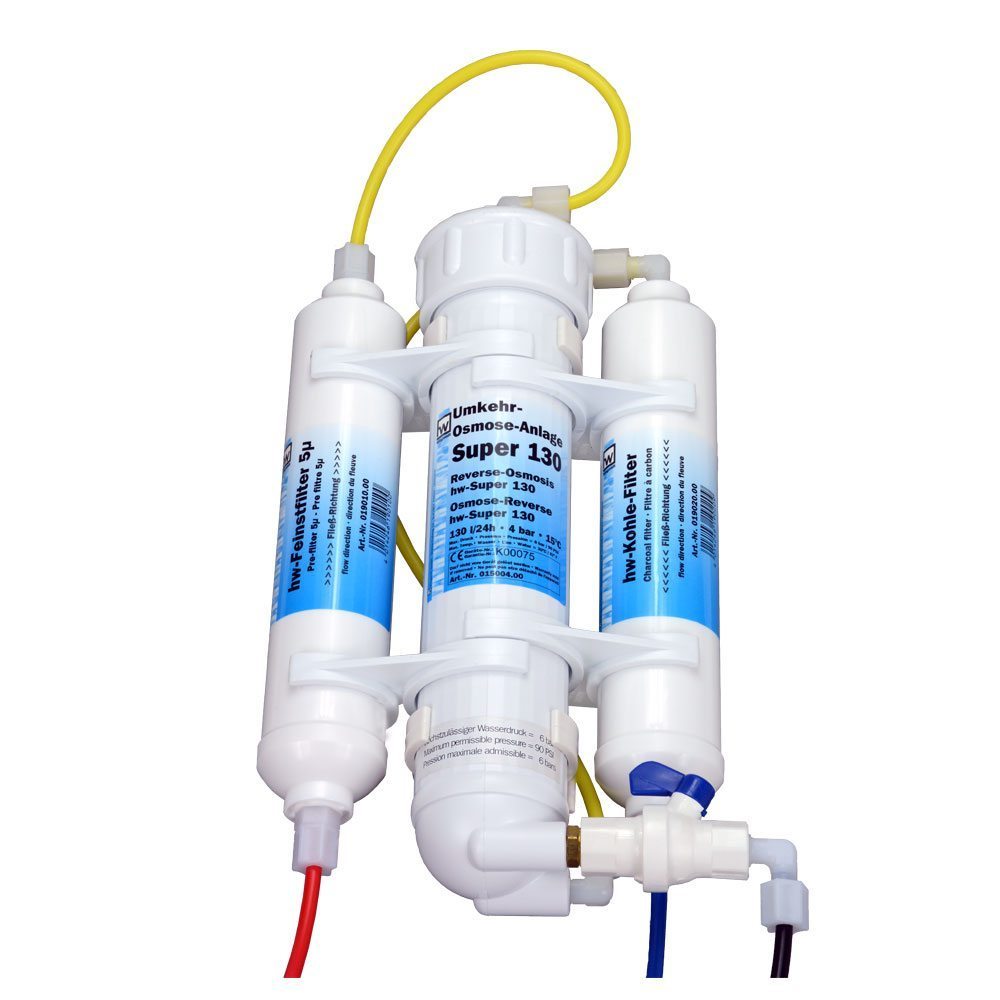
hw reverse osmosis systems with tested performance data
The model output figures in the original catalogue are based on test conditions of 4 bar and 15 °C. Actual permeate output depends on operating conditions and source water.
In reverse osmosis, pressurised tap water is directed against a semipermeable membrane. Some of the water passes through the membrane and is collected as permeate. Many dissolved salts and unwanted substances are retained and discharged with the concentrate.
Rejection varies by substance and is influenced by the source water, operating pressure, temperature and membrane condition. Refer to the substance-specific rejection values in the product catalogue.
The standard hw flushing valve is factory-set for the respective membrane. Follow the flushing instructions and check the permeate-to-concentrate ratio during operation.
Operating parameters
- Water pressure: 3 to a maximum of 6 bar
- Water temperature: 5 to a maximum of 40 °C
- Water-hardness limits: 22 °dKH and 30–33 °dGH
- Salt content: maximum 2000 mg/l
- Permeate-to-concentrate ratio: 1:3 to 1:3.5
The units are not suitable for treating well water or groundwater with an iron content above 0.1 mg/l. Iron deposits can clog the membrane and render it unusable.
hw polyvinyl membrane
hw reverse osmosis systems use hw polyvinyl membranes made from fully synthetic material. Reliable operation requires compliance with the stated operating limits, appropriate prefiltration and regular maintenance.
The activated carbon filter is positioned according to the application. The original catalogue describes a filter at the permeate outlet for post-treatment on units supplied for use in Germany. Where shock chlorination may occur, the filter is fitted between the fine filter and the membrane for additional protection. Follow the connection instructions for your unit.
The stated operating limits are a salt content of up to 2000 mg/l, carbonate hardness of up to 22 °dKH, a pH range of 3 to 10, and a source-water general-hardness limit in the range 30–33 °dGH.
The original catalogue specifies chlorine tolerance of up to 1 mg/l for the hw polyvinyl membrane. Higher chlorine concentrations require the additional protection described there.
Learn more about operation and maintenance of hw reverse osmosis systems