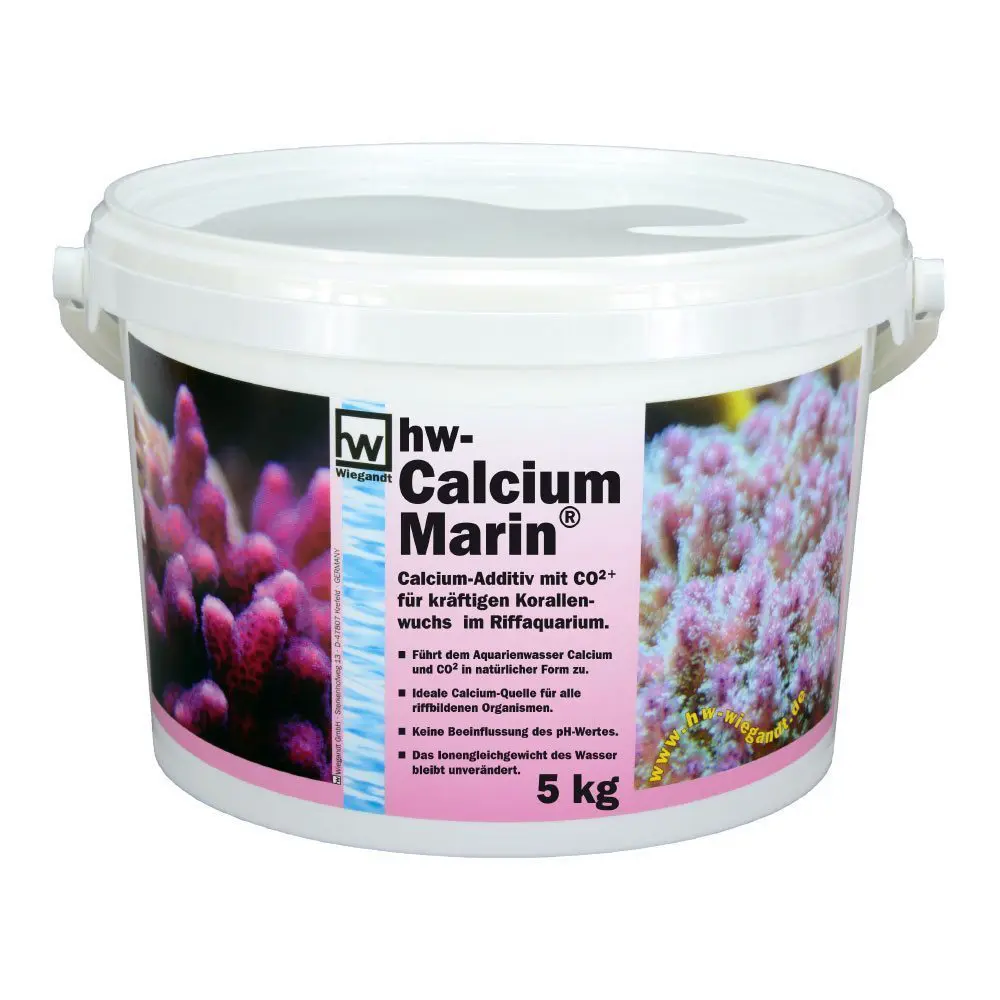
Description
Mineralisation for alkaline freshwater aquariums
hw MineralMarin can be used to mineralise reverse osmosis or demineralised water for fish from Lake Tanganyika and Lake Malawi. Check the source water and adjust total hardness, alkalinity and conductivity to the needs of the species you keep. Adding it to tap water does not automatically reproduce the composition of either lake.
Increasing hardness and mineral content
According to the product instructions, one measuring scoop (approximately 5 g) dissolved in 10 litres of reverse osmosis or demineralised water gives a total hardness of approximately 10–11 °dGH and a conductivity of approximately 680–700 µS/cm. Check the resulting values by testing.
Calcium and carbonate supplementation in seawater
The Balling method
In the Balling method, calcium chloride dihydrate (CaCl₂ · 2H₂O) and sodium bicarbonate (NaHCO₃) supply calcium and carbonate hardness. Sodium and chloride remain in the water. Their accumulation can gradually change the relative composition of the aquarium water.
A NaCl-free mineral salt mixture such as hw MineralMarin supplies the complementary salt components. Monitor salinity and density regularly, as these additions can increase the salt concentration. Correct an increase as necessary during water changes.
Preparing the solutions
Prepare three separate solutions using reverse osmosis or demineralised water:
- Container I: 213.50 g hw calcium chloride dihydrate per 2 litres of water.
- Container II: 163.80 g hw sodium bicarbonate per 2 litres of water.
- Container III: 48.75 g hw MineralMarin per 2 litres of water.
Using the prepared solutions
The instructions describe a calcium increase of 50 mg/l together with an increase in carbonate hardness of approximately 7 °dKH.
Start by adding 5 ml of each solution per 10 litres of aquarium water. Measure calcium and carbonate hardness daily. Increase both values gradually. Once the target values are reached, adjust the dose in steps of approximately 10 % until the values remain stable. Once a suitable dose is established, the instructions recommend weekly checks.
Seasonal changes in temperature or light, coral growth and changes in stocking can alter consumption and require dose adjustments.
Magnesium and carbonate supplementation
The procedure follows the calcium version, replacing calcium chloride in container I with magnesium chloride hexahydrate:
- Container I: 199.20 g hw magnesium chloride hexahydrate (MgCl₂ · 6H₂O) per 2 litres of reverse osmosis or demineralised water.
- Container II: 163.80 g hw sodium bicarbonate per 2 litres of water.
- Container III: 48.75 g hw MineralMarin per 2 litres of water.
Follow the same dosing procedure as for the calcium version, while allowing for the lower magnesium consumption. A one-off correction may be sufficient when magnesium is low; a further measurable decline may take weeks or months. Monitor the concentration and avoid values above 1,600 mg/l, which can adversely affect reef organisms. The existing instructions give 1,250–1,380 mg/l as a reference range and describe water changes as a way of reducing excessive concentrations.